Morphology Study and Catalytic Application of Cobalt-Functionalized Porous Organic-Inorganic Hybrid Nanomaterials
Zhangjiang National Laboratory, China
Author and article information
Cite this as
Gao S. Morphology Study and Catalytic Application of Cobalt-Functionalized Porous Organic-Inorganic Hybrid Nanomaterials. Open J Chem. 2026; 12(1): 1-3. Available from: 10.17352/ojc.000045
Copyright License
© 2026 Gao S. This is an open-access article distributed under the terms of the Creative Commons Attribution License, which permits unrestricted use, distribution, and reproduction in any medium, provided the original author and source are credited.Porous organic-inorganic hybrid nanomaterials have attracted enormous attention in the field of heterogeneous catalysis due to their tunable morphology, high specific surface area, and synergistic effect between organic and inorganic components. In this work, a facile one-pot synthesis strategy was developed to fabricate cobalt-functionalized porous organic-inorganic hybrid nanomaterials with controllable morphologies. Hybrid materials showed excellent catalytic activity, selectivity, and recyclability. The enhanced catalytic performance was attributed to the porous structure, uniform dispersion of Co active sites, and strong synergistic interaction between the organic PS-b-P4VP matrix and inorganic Co components.
Porous organic-inorganic hybrid nanomaterials have emerged as promising heterogeneous catalysts due to their unique structural advantages [1-4]. The organic component can provide flexible skeletons, tunable functional groups, and good dispersibility, while the inorganic component can offer high catalytic activity, thermal stability, and mechanical strength [5]. The synergistic effect between organic and inorganic phases can effectively improve the catalytic performance, stability, and recyclability of the materials. Among various inorganic components, Cobalt (Co)-based materials have attracted wide attention in alcohol oxidation reactions due to their low cost, abundant reserves, and excellent redox properties. However, the aggregation of Co Nanoparticles (Co NPs) during the synthesis process often leads to a decrease in catalytic activity and selectivity, which limits their practical application [6].
To solve the above problem, the introduction of porous organic matrices to disperse Co NPs is an effective strategy. Poly (styrene)-b-poly (4-vinylpyridine) (PS-b-P4VP), a typical block copolymer, has been widely used as an organic matrix for the preparation of hybrid materials due to its unique structure and properties. The hydrophobic polystyrene (PS) block can provide a stable skeleton, while the hydrophilic poly (4-vinylpyridine) (P4VP) block contains pyridine groups that can coordinate with metal ions, thereby effectively dispersing metal NPs and preventing their aggregation. In this work, we report a facile one-pot synthesis of cobalt-functionalized porous organic-inorganic hybrid nanomaterials with controllable morphologies using PS-b-P4VP as the organic matrix, CoCO3 as the cobalt source, and NH3·H2O as the precipitant and coordination agent.
The organic-inorganic hybrid catalyst composed of cobalt carbonate (CoCO3) and polystyrene-block-poly (4-vinylpyridine) (PS-P4VP) hyper-cross-linked polymer (HCLP) was fabricated via a facile solution-phase mixing and self-assembly strategy, where the synergistic interfacial interaction and selective solvent-induced structural regulation endow the hybrid material with uniform component distribution and well-defined porous architecture. As a typical amphiphilic diblock copolymer, PS-P4VP consists of hydrophobic polystyrene segments and weakly basic poly (4-vinylpyridine) segments with abundant pyridine functional groups, exhibiting intrinsic pH responsiveness and selective affinity toward metal-based inorganic components, which serve as an ideal porous organic support for anchoring and dispersing cobalt carbonate active species. The hyper-cross-linked PS-P4VP polymer was pre-synthesized through a classical Friedel-Crafts crosslinking reaction, which constructs a rigid, permanently porous three-dimensional network structure with abundant exposed pyridine active sites on the polymer surface and pore channels, which provide sufficient space and binding sites for the immobilization of inorganic cobalt components.
The entire hybridization process was carried out in a homogeneous organic solvent system with moderate polarity, which enables the full dissolution and dispersion of PS-P4VP hypercrosslinked polymer and the uniform exfoliation and dispersion of cobalt carbonate nanoparticles. Typically, the hyper-cross-linked PS-P4VP powder was first ultrasonically dispersed in N, N-dimethylformamide (DMF) or a mixed DMF/tetrahydrofuran (THF) cosolvent system. The ultrasonic treatment lasting for 30-60 min further disassembles the tiny polymer aggregates, making the internal porous channels and surface pyridine groups of PS-P4VP fully exposed to the solvent environment, which lays a foundation for subsequent interfacial bonding with cobalt carbonate. Subsequently, quantitative cobalt carbonate micro/nanoparticles in NH3·H2O were gradually added into the homogeneous PS-P4VP dispersion under continuous magnetic stirring at a constant temperature. The hyper-cross-linked rigid network of PS-P4VP effectively restricts the migration and agglomeration of CoCO nanoparticles, realizing the uniform dispersion of active sites in the polymer matrix. After sufficient solvent evaporation and low-temperature vacuum drying, the stable CoCO/PS-P4VP organic-inorganic hybrid catalyst is finally obtained.
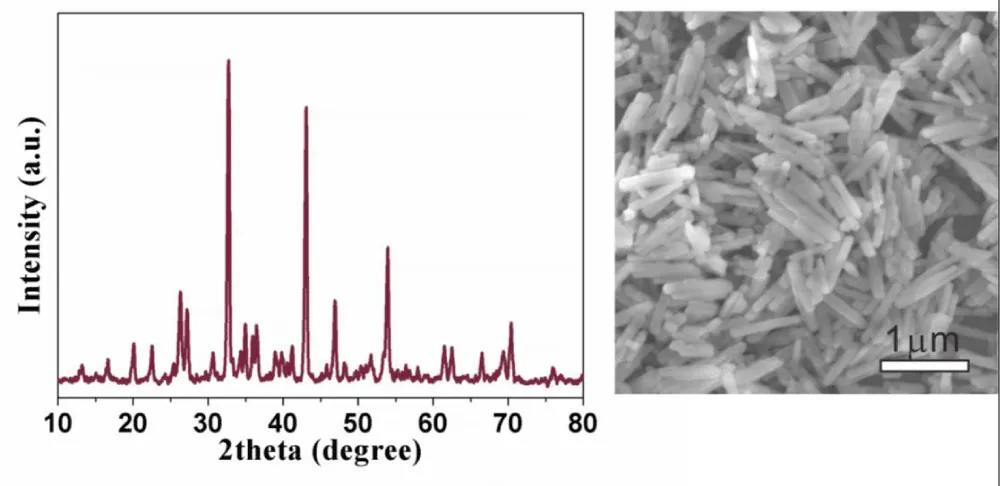
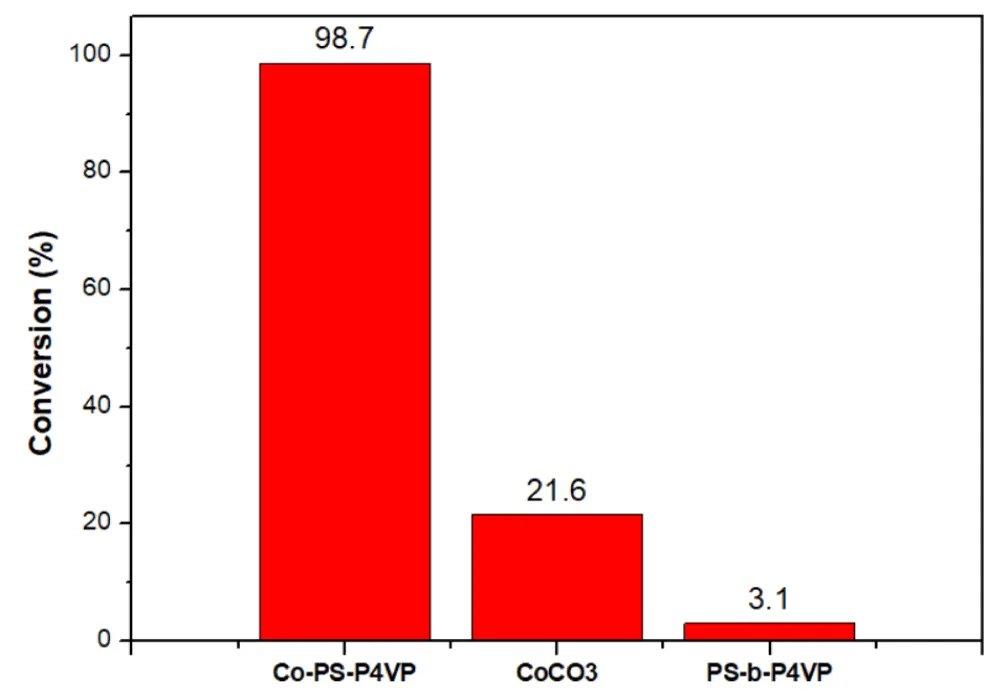
Figure 1 shows the XRD and SEM images of the hybrid nanomaterials with morphologies. Indicating that CoCO3 is successfully loaded in the hybrid materials. The cobalt content in the hybrid materials was determined by ICP-AES. The results show that the cobalt content of Co-PS-P4VP is 12.3 wt%. The higher cobalt content of Co-PS-P4VP is due to the fact that more CoCO3 can be loaded in the nanorod matrix, which is consistent with the SEM results. As shown in Figure 2, the catalytic performance of the hybrid nanomaterials was evaluated. For Co-PS-P4VP, the conversion rate reaches 98.7%, and the selectivity is 99.2%, which is superior to that of most reported Co-based catalysts. The excellent catalytic performance of the hybrid materials is attributed to the following factors: (1) the porous structure provides a large specific surface area and abundant pore channels, which is beneficial to the adsorption and diffusion of reactants and products; (2) the uniform dispersion of Co NPs in the PS-b-P4VP matrix prevents the aggregation of Co NPs, leading to more exposed active sites; (3) the strong coordination between pyridine N and Co2+ ions enhances the synergistic effect between organic and inorganic phases, thereby improving the catalytic activity and selectivity. The recyclability and stability of the catalyst are crucial for its practical application. The recyclability of Co-PS-P4VP-NS was tested by repeating the catalytic oxidation of benzyl alcohol for 5 cycles. After 5 cycles, the conversion rate of benzyl alcohol decreases slightly from 98.7% to 95.3%, and the selectivity remains above 99%, indicating that the catalyst has good recyclability. The slight decrease in catalytic activity may be due to the small amount of catalyst loss during the centrifugation and washing process.
In summary, we have successfully synthesized cobalt-functionalized porous organic-inorganic hybrid nanomaterials with controllable nanorod morphologies by a facile one-pot method using PS-b-P4VP as the organic matrix, CoCO3 as the cobalt source, and NH3·H2O as the precipitant and coordination agent. The nanoshaped hybrid material (Co-PS-P4VP) exhibits excellent catalytic performance. It also has good substrate universality and recyclability, which is attributed to the porous structure, uniform dispersion of Co active sites, and strong synergistic interaction between organic and inorganic phases. This work provides a simple and efficient approach for the preparation of morphology-controllable Co-based porous organic-inorganic hybrid catalysts, which have great potential in the field of selective oxidation catalysis.
- Sheldon RA. Catalysis of the oxidation of alcohols by molecular oxygen. Chem Rev. 2014;114(20):10811-10838.
- Jia C, Li Y, Wang A. Recent advances in heterogeneous catalysis for selective oxidation of alcohols to aldehydes/ketones. Chem Soc Rev. 2018;47(21):8120-8172.
- Zhang X, Chen J, Li J. Metal-organic frameworks and their derivatives as catalysts for selective oxidation of alcohols. Adv Mater. 2020;32:2001184.
- Xu J, Wang X, Chen L. Porous organic-inorganic hybrid materials: from synthesis to applications. Chem Rev. 2018;118(9):4744-4802.
- Wang Y, Li Z, Zhang H. Synergistic effects in organic-inorganic hybrid catalysts for heterogeneous catalysis. Acc Chem Res. 2019;52(10):2676-2684.
- Liu C, Zhang L, Wang J. Organic-inorganic hybrid materials: a new class of heterogeneous catalysts. Catal Sci Technol. 2017;7(21):4887-4908.

 Save to Mendeley
Article Alerts
Subscribe to our articles alerts and stay tuned.
 This work is licensed under a Creative Commons Attribution 4.0 International License.