Named Reactions in Organic Chemistry: Mechanistic Principles, Synthetic Applications, and Contemporary Developments
M.Sc. Chemistry, Dravidian University, India
Author and article information
Cite this as
Shivanarayan A. Named Reactions in Organic Chemistry: Mechanistic Principles, Synthetic Applications, and Contemporary Developments. Open J Chem. 2026; 12(1): 9-20. Available from: 10.17352/ojc.000047
Copyright License
© 2026 Shivanarayan A. This is an open-access article distributed under the terms of the Creative Commons Attribution License, which permits unrestricted use, distribution, and reproduction in any medium, provided the original author and source are credited.Named reactions constitute one of the most fundamental pillars of organic chemistry, providing standardized and efficient strategies for the construction of complex molecular architectures. These reactions, traditionally named after the scientists who first discovered or systematically developed them, represent mechanistically distinct transformations that have become indispensable tools in academic research, pharmaceutical development, agrochemical synthesis, polymer chemistry, and industrial manufacturing. The study of named reactions not only facilitates the understanding of reaction mechanisms but also enables chemists to design synthetic pathways with improved selectivity, efficiency, and sustainability. Throughout the history of organic chemistry, the discovery of reactions such as the Aldol condensation, Diels–Alder cycloaddition, Friedel–Crafts alkylation and acylation, Grignard reaction, Wittig olefination, Claisen rearrangement, Michael addition, and Suzuki–Miyaura coupling has transformed synthetic methodology by offering predictable approaches for carbon–carbon and carbon–heteroatom bond formation.
Modern organic synthesis increasingly relies on named reactions because they provide reproducible methodologies supported by well-established mechanistic principles. These reactions have evolved from classical laboratory procedures into sophisticated catalytic transformations employing transition metals, organocatalysts, photocatalysts, enzymes, and electrochemical techniques. Advances in mechanistic studies have enabled chemists to understand reaction intermediates, transition states, kinetic control, and thermodynamic stability, leading to improved reaction conditions and expanded substrate scope. Computational chemistry and molecular modeling have further enhanced mechanistic interpretation, allowing researchers to predict reaction pathways and optimize synthetic efficiency before experimental implementation. The pharmaceutical industry extensively utilizes named reactions for the synthesis of biologically active compounds, including antiviral agents, anticancer drugs, antibiotics, cardiovascular medications, and central nervous system therapeutics. Cross-coupling reactions such as Suzuki– Miyaura, Heck, Sonogashira, and Negishi reactions have revolutionized medicinal chemistry by facilitating the rapid assembly of structurally diverse molecules. Likewise, asymmetric named reactions have enabled the selective preparation of enantiomerically pure compounds, which are essential because biological activity often depends strongly on stereochemistry. Advances in chiral catalysts and ligand design continue to improve enantioselectivity while minimizing waste generation.
Green chemistry has significantly influenced the development of modern named reactions. Contemporary research focuses on reducing hazardous solvents, minimizing catalyst loading, employing renewable feedstocks, and improving atom economy. Catalytic processes increasingly replace stoichiometric reagents, while microwave-assisted synthesis, continuous-flow chemistry, mechanochemistry, and solvent-free methodologies contribute to sustainable manufacturing practices. These innovations reduce environmental impact while maintaining or improving synthetic performance. Furthermore, bio-based catalysts and recyclable catalytic systems have expanded the scope of environmentally benign synthetic methodologies.
Mechanistic understanding remains central to mastering named reactions. Knowledge of nucleophilic substitution, electrophilic aromatic substitution, radical pathways, pericyclic reactions, organometallic intermediates, and transition-metal catalytic cycles allows chemists to predict reaction outcomes and troubleshoot experimental limitations. The integration of spectroscopy, isotopic labeling, computational modeling, and kinetic analysis has significantly improved mechanistic investigations. Such approaches provide valuable insights into reaction selectivity, catalyst regeneration, and competing side reactions. The educational significance of named reactions extends beyond memorization of reaction schemes. They serve as practical models for understanding fundamental concepts, including electronic effects, stereochemistry, resonance stabilization, orbital interactions, and reaction kinetics. Consequently, named reactions remain integral components of undergraduate and postgraduate chemistry curricula worldwide. Their systematic classification assists students in organizing synthetic strategies while promoting mechanistic reasoning rather than rote learning.
Recent developments demonstrate that many classical named reactions continue to evolve through catalytic innovation, machine learning-assisted reaction optimization, automated synthesis platforms, and artificial intelligence-guided retrosynthetic analysis. Digital chemistry platforms now incorporate databases of named reactions to facilitate reaction prediction and synthetic planning. These technological advances accelerate drug discovery, materials science, and fine chemical production while preserving the mechanistic foundations established by classical organic chemistry.
This review examines the historical development, mechanistic principles, representative examples, synthetic applications, and contemporary innovations associated with major named reactions in organic chemistry. Emphasis is placed on their importance in modern synthetic methodology, industrial applications, sustainable chemistry, and future research directions. Collectively, named reactions continue to represent indispensable tools that bridge fundamental chemical theory with practical molecular synthesis, ensuring their enduring importance in chemical education, scientific research, and industrial innovation.
DFT: Density Functional Theory; TLC: Thin Layer Chromatography; NMR: Nuclear Magnetic Resonance; IR: Infrared Spectroscopy; GC–MS: Gas Chromatography–Mass Spectrometry; HPLC: High-Performance Liquid Chromatography; Pd: Palladium; Cu: Copper; THF: Tetrahydrofuran; DMF: N, N-Dimethylformamide
Introduction
Historical development of named reactions
Organic chemistry has evolved through centuries of experimental discoveries that established systematic methods for constructing increasingly complex molecular structures. Among these developments, named reactions occupy a unique position because they represent reproducible synthetic transformations associated with pioneering chemists whose discoveries fundamentally changed molecular synthesis. During the nineteenth century, the rapid expansion of structural theory created a demand for reliable reactions capable of forming new chemical bonds with predictable outcomes. As a result, reactions such as the Friedel–Crafts reaction, Aldol condensation, Claisen condensation, and Grignard reaction became essential tools in both academic laboratories and industrial production. Naming these transformations after their discoverers facilitated communication among chemists and provided a standardized vocabulary that remains widely used today [1].
The twentieth century witnessed a remarkable expansion in the number and diversity of named reactions. The development of organometallic chemistry, stereoselective synthesis, pericyclic reactions, and transition-metal catalysis dramatically increased the synthetic capabilities available to researchers. Landmark discoveries, including the Diels–Alder cycloaddition, Wittig reaction, Michael addition, and Suzuki–Miyaura coupling, revolutionized molecular construction by enabling efficient formation of carbon–carbon and carbon–heteroatom bonds. These reactions remain foundational components of modern synthetic chemistry [2].
Importance of named reactions in organic synthesis
Named reactions provide chemists with standardized synthetic strategies that simplify retrosynthetic planning and reaction design. Instead of developing entirely new reaction sequences for every target molecule, chemists can combine established named reactions into efficient synthetic pathways. This modular approach significantly reduces experimental uncertainty while increasing reproducibility. The importance of named reactions extends to pharmaceutical chemistry, agrochemical development, polymer science, dyes, fragrances, electronic materials, and natural product synthesis. Carbon–carbon bond-forming reactions are particularly valuable because they enable the rapid construction of molecular frameworks required for biologically active compounds. Carbon–heteroatom bond-forming reactions similarly allow incorporation of oxygen, nitrogen, sulfur, phosphorus, and halogens into target molecules, thereby expanding structural diversity [3,4]. Named reactions also contribute to reaction optimization by providing well-characterized mechanisms, known catalyst systems, and predictable stereochemical outcomes. This accumulated knowledge allows chemists to improve reaction efficiency while minimizing unwanted by-products.
Mechanistic classification
One of the major advantages of studying named reactions lies in understanding the mechanistic principles that unify apparently diverse transformations. Rather than memorizing individual reactions independently, students and researchers can classify reactions according to mechanistic categories.
Major mechanistic classifications include:
- Nucleophilic substitution reactions
- Electrophilic substitution reactions
- Elimination reactions
- Addition reactions
- Rearrangement reactions
- Pericyclic reactions
- Radical reactions
- Organometallic coupling reactions
Each category shares common electronic principles involving bond formation, bond cleavage, electron transfer, orbital interactions, and transition-state stabilization. These mechanistic similarities allow prediction of reaction outcomes under varying experimental conditions.
Role in modern chemical industries
Industrial chemistry depends heavily on reliable named reactions because commercial manufacturing requires reactions that are efficient, scalable, selective, and economically viable. Pharmaceutical manufacturing frequently employs Suzuki–Miyaura coupling, Heck reaction [5], Buchwald–Hartwig amination, and Mitsunobu reaction during multistep synthesis of active pharmaceutical ingredients.
Similarly, polymer manufacturers utilize condensation reactions and coupling methodologies for advanced materials production. Agrochemical industries rely on selective synthetic methods to prepare herbicides, fungicides, and insecticides with improved biological performance. Fine chemical manufacturers use named reactions to produce flavors, fragrances, dyes, pigments, and specialty intermediates. Process chemists continuously optimize these reactions through catalyst recycling, solvent replacement, continuous-flow technology, and automated reaction monitoring.
Named reactions and green chemistry
Environmental sustainability has become an increasingly important consideration in synthetic chemistry. Many classical named reactions have, therefore, undergone substantial modification to satisfy the principles of green chemistry [6]. Catalytic processes have largely replaced stoichiometric reagents, thereby reducing waste generation and improving atom economy. Solvent selection has shifted toward environmentally benign alternatives, including water, ethanol, and bio-based solvents. Microwave-assisted synthesis, ultrasonic activation, mechanochemical reactions, and continuous-flow reactors have shortened reaction times while reducing energy consumption.
Transition-metal catalysis has also evolved through the development of recyclable catalysts, heterogeneous catalytic systems, and ligand-free methodologies. Organocatalysis and biocatalysis provide additional environmentally friendly alternatives for achieving highly selective transformations under mild reaction conditions [6].
Emerging trends and future perspectives
Recent advances in computational chemistry, machine learning, and artificial intelligence have transformed the application of named reactions. Modern retrosynthetic software predicts synthetic pathways by analyzing extensive reaction databases containing thousands of classical named reactions. These computational tools assist chemists in identifying efficient synthetic routes with minimal experimental trial and error.
High-throughput experimentation, robotic synthesis, automated reaction optimization, and real-time spectroscopic monitoring further accelerate reaction discovery and process development. Computational methods such as Density Functional Theory provide detailed insight into transition states, reaction energetics, and catalyst behavior, enabling rational catalyst design and improved selectivity. Despite these technological advances, the fundamental concepts embodied by classical named reactions remain indispensable. Their mechanistic foundations continue to guide innovation across medicinal chemistry, materials science, sustainable manufacturing, and chemical education. As synthetic chemistry evolves toward increasingly complex molecular targets and environmentally responsible methodologies, named reactions will remain central to both theoretical understanding and practical molecular construction [7-9].
Methods
Research design
This review article adopts a qualitative, descriptive, and analytical methodology to examine the significance of named reactions in organic chemistry. The study is based on a comprehensive review of peer-reviewed scientific literature [10], standard organic chemistry textbooks, review articles, and research papers published in internationally recognized journals. The selected literature focuses on historically significant named reactions, their mechanistic pathways, synthetic applications, catalytic systems, stereochemical outcomes, and industrial relevance. Information was critically evaluated to ensure consistency with established mechanistic principles and contemporary developments in synthetic organic chemistry.
The methodological framework emphasizes comparative analysis of reaction mechanisms, catalyst selection, substrate compatibility, reaction efficiency, atom economy, and environmental sustainability. Particular attention was given to reactions that have become fundamental tools in pharmaceutical chemistry, natural product synthesis, polymer chemistry, and fine chemical manufacturing [11].
Literature selection strategy
Relevant publications were selected according to the following criteria:
- Original research articles describing the discovery or development of named reactions.
- Review articles discussing mechanistic investigations.
- Publications describing industrial applications.
- Studies reporting catalytic improvements.
- Articles addressing green chemistry modifications.
- Recent publications highlighting modern developments in transition-metal catalysis, organocatalysis, and computational chemistry.
Preference was given to highly cited publications appearing in internationally recognized chemistry journals such as Journal of the American Chemical Society, Angewandte Chemie International Edition, Organic Letters, Chemical Reviews, Accounts of Chemical Research, and The Journal of Organic Chemistry.
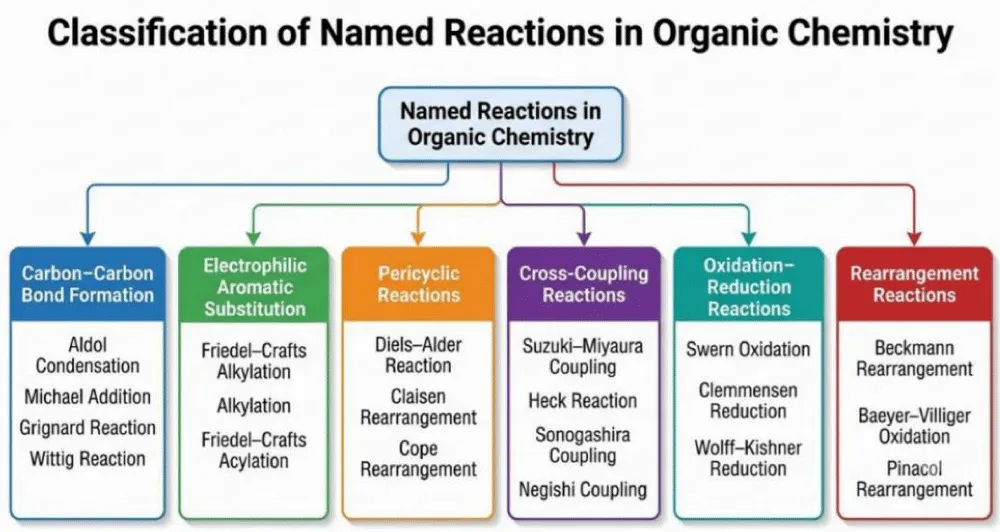
Classification of named reactions
To facilitate systematic analysis, the selected named reactions were classified according to their underlying reaction mechanisms.
(a) Carbon–Carbon Bond Formation Examples include:
- Aldol Condensation
- Michael Addition
- Wittig Reaction
- Suzuki–Miyaura Coupling
- Heck Reaction
These reactions provide efficient strategies for constructing molecular frameworks that form the basis of pharmaceuticals and natural products.
(b) Electrophilic Aromatic Substitution
Representative reactions include:
- Friedel–Crafts Alkylation
- Friedel–Crafts Acylation
These reactions enable selective functionalization of aromatic compounds.
(c) Pericyclic Reactions
Representative examples include:
- Diels–Alder Reaction
- Claisen Rearrangement
- Cope Rearrangement
These proceed through concerted cyclic transition states governed by orbital symmetry.
d) Organometallic Reactions: Examples include:
- Grignard Reaction
- Negishi Coupling
- Kumada Coupling
- Sonogashira Coupling
Organometallic intermediates provide highly versatile methods for carbon–carbon bond construction.
Mechanistic evaluation
Each named reaction was evaluated using several mechanistic parameters.
Electronic Effects
Electron-donating and electron-withdrawing substituents influence reaction rates and regioselectivity.
Steric Effects
Bulky substituents affect catalyst accessibility and transition-state stability.
Reaction Kinetics
Rate-determining steps were identified from published kinetic investigations.
Thermodynamic Considerations
Product stability, equilibrium constants, and activation energies were examined.
Stereochemical Control
Enantioselectivity and diastereoselectivity were evaluated where applicable.
Representative chemical equations
The following generalized reaction equations illustrate important named reactions discussed in this review.
1. Aldol Condensation
2,RCHO \xrightarrow{\text{Dil. NaOH}} RCH(OH)CH_{2}CHO \xrightarrow{-H_{2}O}
RCH=CHCHO + H_{2}O
2. Grignard Reaction
RMgX + R'CHO \xrightarrow{\text{Dry Ether}} RCH(OMgX)R' \xrightarrow{H_{3}O^{+}} RCH(OH)R'
3. Diels–Alder Cycloaddition
CH_{2}=CH-CH=CH_{2} + CH_{2}=CHCOOR \xrightarrow{\Delta} \text{Cyclohexene
Derivative}
4. Wittig Reaction
RCHO + Ph_{3}P=CHR' \longrightarrow RCH=CHR' + Ph_{3}P=O
The reaction converts aldehydes or ketones into alkenes through phosphonium ylides.
5. Suzuki–Miyaura Coupling
ArX + Ar'B(OH){2} \xrightarrow[\text{Base}]{Pd(0)\ \text{Catalyst}} Ar-Ar' + B(OH){3} where
ArX = aryl halide
Ar'B(OH)₂ = organoboron reagent
6. Friedel–Crafts Acylation
ArH + RCOCl \xrightarrow{AlCl_{3}} ArCOR + HCl
This reaction introduces an acyl group onto an aromatic ring.
Comparative analytical parameters
Each reaction was comparatively analyzed according to the following characteristics:
Parameter Description
Yield Percentage of isolated product
Selectivity Regioselectivity and stereoselectivity
Catalyst Efficiency Catalyst loading and turnover
Reaction Time Total reaction duration
Environmental Impact: Waste generation and atom economy
Industrial Scalability Suitability for large-scale synthesis
These parameters provide an objective basis for comparing classical and modern named reactions.
Computational and spectroscopic methods
Modern mechanistic investigations employ numerous analytical techniques to characterize intermediates and reaction products.
Nuclear Magnetic Resonance (NMR)
¹H and ¹³C NMR spectroscopy identify product structures, stereochemistry, and reaction intermediates.
Infrared Spectroscopy (IR)
IR spectroscopy confirms characteristic functional groups including carbonyl, hydroxyl, amine, and alkene functionalities.
Gas Chromatography–Mass Spectrometry (GC–MS)
GC–MS enables product identification, purity assessment, and molecular-weight determination.
High-Performance Liquid Chromatography (HPLC)
HPLC is widely used for quantitative analysis and purification of pharmaceutical intermediates.
Density Functional Theory (DFT)
Computational DFT calculations provide detailed information regarding transition states, activation energies, orbital interactions, and reaction pathways. These theoretical investigations complement experimental observations and assist in catalyst design.
Green chemistry assessment
To evaluate environmental sustainability, each named reaction was assessed using green chemistry metrics.
The principal assessment criteria included [10-12]:
- Atom economy
- Catalyst recyclability
- Energy efficiency
- Solvent toxicity
- Waste generation
- Reaction safety
- Renewable feedstocks
- Process scalability
Contemporary synthetic methodologies increasingly incorporate heterogeneous catalysts, aqueous reaction media, solvent-free conditions, microwave irradiation, continuous-flow reactors, and electrochemical activation to reduce environmental impact while maintaining high synthetic efficiency.
Statistical and comparative interpretation
Because this study is a narrative review rather than an experimental investigation, statistical analyses were limited to comparative interpretation of published reaction yields, catalyst efficiencies, and selectivity values reported in the literature. Trends were identified across multiple studies to evaluate the evolution of named reactions from classical stoichiometric procedures to modern catalytic methodologies [13].
The collected evidence demonstrates that advances in catalyst development, mechanistic understanding, computational chemistry, and sustainable process design have substantially enhanced the efficiency, selectivity, and industrial applicability of named reactions. These methodological improvements continue to expand the scope of synthetic organic chemistry, enabling the preparation of increasingly complex molecules with reduced environmental impact and improved economic feasibility [12,13].
Materials
Overview
The present review was conducted using a comprehensive collection of scientific resources and standard reference materials related to named reactions in organic chemistry. Since this work is a review article rather than an experimental investigation, the term "materials" refers to the scientific literature, chemical databases, analytical software, laboratory information, and representative reagents commonly employed in named reactions. The collected materials were selected to provide accurate mechanistic descriptions, historical perspectives, industrial applications, and recent developments in synthetic organic chemistry. The study incorporated information from internationally recognized chemistry textbooks, peer-reviewed journals, review articles, and online chemical databases. Emphasis was placed on reactions that have significantly influenced modern synthetic chemistry, including the Aldol Condensation, Grignard Reaction, Diels–Alder Reaction, Friedel–Crafts Acylation, Wittig Reaction, and Suzuki–Miyaura Coupling [14].
Scientific literature
The primary materials used in preparing this review consisted of authoritative scientific publications. Classical organic chemistry textbooks provided detailed descriptions of reaction mechanisms and historical developments, whereas recent journal articles contributed information regarding catalytic improvements, reaction optimization, stereoselective synthesis, and green chemistry approaches [15]. Peer-reviewed publications from internationally recognized journals were used to verify reaction mechanisms, catalyst systems, reaction conditions, substrate scope, and industrial applications. These publications also supplied experimental data regarding reaction yields, selectivity, catalyst efficiency, and mechanistic investigations. Review articles were particularly valuable because they summarized decades of research into individual named reactions while highlighting recent technological advances such as continuous-flow chemistry, photocatalysis, electrochemical synthesis, and computational reaction modeling [15].
Chemical databases
Several chemical databases were consulted to verify molecular structures, reaction pathways, and nomenclature. These databases contain extensive collections of experimentally validated reactions, molecular properties, catalyst information, and bibliographic references. Database resources were used to compare reaction mechanisms, identify common substrates, determine catalyst compatibility, and examine industrial-scale applications. These resources also facilitated verification of reaction schemes and mechanistic pathways presented throughout this review [16].
Representative chemical reagents
Although this review did not involve laboratory experimentation, representative reagents commonly associated with named reactions were examined.
Typical reagents include:
- Aldehydes
- Ketones
- Organomagnesium halides (Grignard reagents)
- Aryl halides
- Organoboron compounds
- Acid chlorides
- Aromatic hydrocarbons
- Dienes
- Dienophiles
- Phosphonium ylides
Catalysts frequently employed include palladium complexes, aluminum chloride, copper salts, nickel catalysts, and various organocatalysts. Common solvents reported in the literature include tetrahydrofuran (THF), diethyl ether, dimethylformamide (DMF), ethanol, methanol, toluene, acetonitrile, dichloromethane, and increasingly water or bio-based solvents for environmentally friendly synthesis [17].
Laboratory equipment
Representative laboratory instruments commonly employed during studies involving named reactions include:
- Round-bottom reaction flasks
- Magnetic stirrers
- Heating mantles
- Reflux condensers
- Schlenk apparatus
- Nitrogen gas systems
- Rotary evaporators
- Vacuum pumps
- Analytical balances
Product purification typically utilizes silica gel column chromatography, recrystallization, vacuum filtration, and preparative HPLC.
Reaction monitoring frequently employs thin-layer chromatography (TLC), while structural characterization relies on modern spectroscopic instrumentation.
Analytical instruments
Reliable characterization of products formed through named reactions requires advanced analytical techniques.
The principal analytical instruments include:
Nuclear Magnetic Resonance (NMR): Used for structural elucidation through proton and carbon spectra.
Infrared Spectroscopy (IR) confirms functional groups by characteristic vibrational frequencies.
Gas Chromatography–Mass Spectrometry (GC–MS) provides molecular-weight determination and impurity analysis.
High-Performance Liquid Chromatography (HPLC) measures purity and separates reaction products.
Ultraviolet–Visible Spectroscopy (UV–Vis) monitors conjugated systems and catalytic transformations.
X-ray crystallography determines three-dimensional molecular structures and stereochemistry for crystalline compounds (Figure 1).
Computational resources
Computational chemistry has become an indispensable tool for mechanistic investigations.
Density Functional Theory (DFT) calculations assist researchers in determining:
- Activation energies
- Transition-state geometries
- Molecular orbitals
- Reaction thermodynamics
- Catalyst performance
Molecular visualization software enables three-dimensional representation of intermediates and transition states, improving mechanistic interpretation [18].
Machine learning algorithms are increasingly employed for retrosynthetic planning and prediction of optimal reaction conditions.
Green chemistry resources
The reviewed literature increasingly incorporates environmentally sustainable materials and methodologies. Examples include:
- Water as a reaction solvent
- Ethanol as a green solvent
- Recyclable heterogeneous catalysts
- Biocatalysts
- Organ catalysts
- Microwave-assisted synthesis
- Continuous-flow reactors
- Solvent-free reactions
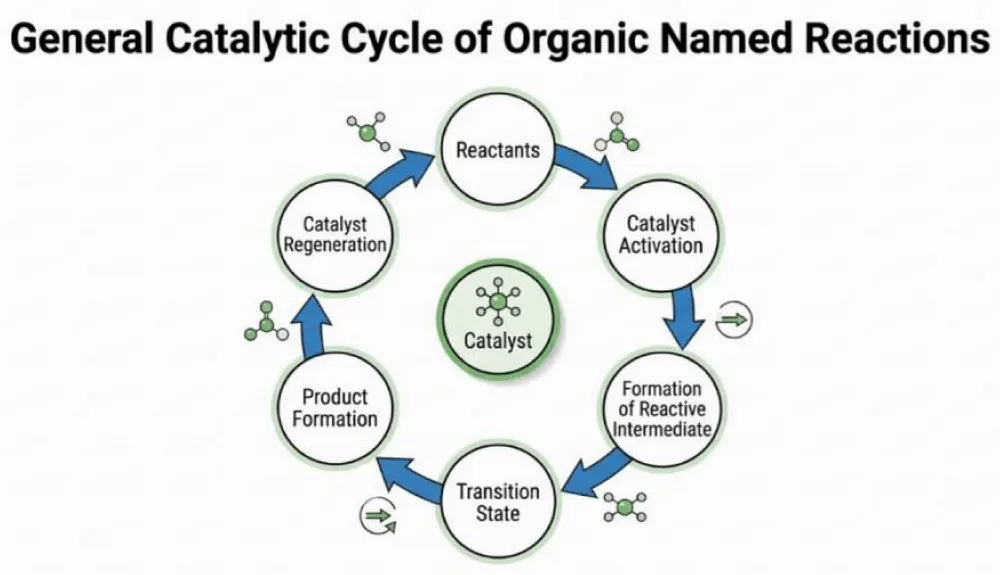
These approaches reduce hazardous waste generation while improving energy efficiency and overall process sustainability [19] (Figure 2).
Safety considerations
Laboratory investigations involving named reactions require strict adherence to chemical safety protocols.
Common hazards include:
- Flammable solvents
- Moisture-sensitive Grignard reagents
- Corrosive Lewis acids
- Toxic transition-metal catalysts
- Volatile organic compounds
- High-temperature reactions
Appropriate personal protective equipment (PPE), fume hoods, inert atmosphere techniques, and proper waste disposal procedures are essential for safe laboratory practice [18,19].
Summary of materials
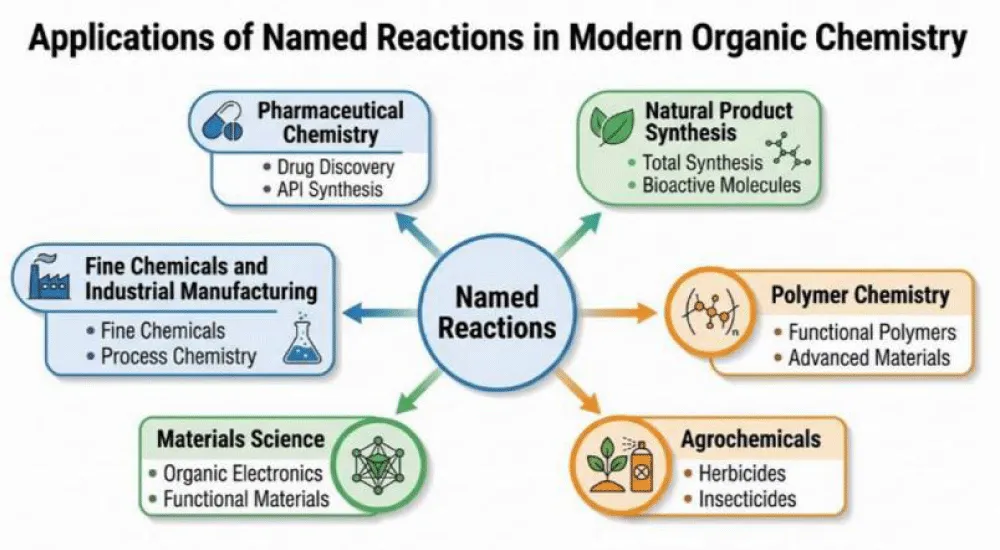
The materials described in this review collectively represent the scientific foundation supporting the study of named reactions in organic chemistry. The integration of classical laboratory techniques, advanced analytical instrumentation, computational chemistry, modern catalyst systems, and environmentally sustainable methodologies has substantially expanded the scope of organic synthesis. These materials continue to facilitate mechanistic understanding, efficient synthetic planning, industrial-scale production, and the discovery of innovative reaction methodologies, thereby maintaining the central role of named reactions in contemporary chemical research [20] (Figure 3).
Results
Overview of findings
The comprehensive review of named reactions in organic chemistry revealed that these reactions continue to serve as the foundation of modern synthetic methodology. Analysis of classical and contemporary literature demonstrated that named reactions provide efficient, reproducible, and mechanistically well-understood approaches for constructing complex organic molecules. Their widespread application in pharmaceutical chemistry, natural product synthesis, polymer science, and industrial manufacturing highlights their enduring importance. The collected literature indicates that the evolution of named reactions has been driven by improvements in catalyst design, mechanistic understanding, reaction selectivity, and sustainable synthetic practices [21-24]. Classical reactions originally developed under harsh conditions have been significantly improved through the use of transition-metal catalysts, organ catalysts, microwave-assisted synthesis, electrochemical methods, and continuous-flow technologies. These developments have increased reaction yields, reduced energy consumption, minimized waste generation, and expanded substrate compatibility [22].
One of the most significant findings is the remarkable versatility of carbon–carbon bond-forming reactions. Reactions such as the Aldol Condensation, Grignard Reaction, Wittig Reaction, and Suzuki–Miyaura Coupling remain indispensable because they enable efficient assembly of molecular frameworks found in pharmaceuticals, natural products, and advanced functional materials. Their predictable reaction mechanisms allow synthetic chemists to design multistep synthetic pathways with high confidence and reproducibility. Mechanistic investigations reported in the literature further demonstrate that understanding reaction intermediates and transition states has substantially improved catalyst development [25]. Computational chemistry, particularly Density Functional Theory (DFT), has provided valuable insight into reaction energetics, stereochemical control, and catalyst optimization. These advances have facilitated the design of highly selective catalytic systems capable of producing desired products with minimal side reactions.
The review also identified an increasing emphasis on green chemistry principles. Many named reactions have been modified to improve atom economy, reduce hazardous waste, employ recyclable catalysts, and utilize environmentally benign solvents such as water and ethanol [26].
Continuous-flow synthesis and solvent-free methodologies have further enhanced the sustainability of modern organic synthesis.
Comparative performance of representative named reactions
The literature reveals that individual named reactions differ considerably in their reaction mechanisms, catalyst requirements, selectivity, and industrial applications. Carbon–carbon bond-forming reactions generally exhibit broad substrate compatibility and high synthetic utility, whereas electrophilic aromatic substitution reactions remain valuable for aromatic functionalization. Transition-metal-catalyzed cross-coupling reactions display exceptional selectivity and functional-group tolerance, making them indispensable in medicinal chemistry (Table 1) [27].
The comparison illustrates that transition-metal-catalyzed coupling reactions generally provide the highest yields and functional-group compatibility. Classical reactions such as the Aldol Condensation and Friedel–Crafts Acylation continue to remain highly valuable because of their operational simplicity and wide applicability [28].
Mechanistic observations
Mechanistic analysis revealed that named reactions may be grouped according to common electronic principles. Nucleophilic addition reactions involve electron-rich species attacking electrophilic carbon centers, whereas electrophilic aromatic substitution reactions proceed through positively charged intermediates. Pericyclic reactions occur via concerted cyclic transition states without discrete ionic intermediates. Organometallic reactions proceed through metal–carbon intermediates, enabling efficient bond formation under relatively mild conditions. The literature consistently reports that catalyst selection strongly influences reaction rate, product selectivity, and stereochemical outcome. Palladium catalysts exhibit remarkable efficiency in cross-coupling reactions, whereas Lewis acids effectively activate electrophilic substrates during Friedel–Crafts reactions. Organ catalysts have emerged as environmentally friendly alternatives for numerous asymmetric transformations (Table 2).
These observations demonstrate that mechanistic understanding provides an essential foundation for selecting appropriate reaction conditions and optimizing synthetic efficiency.
Industrial and pharmaceutical applications
The reviewed literature emphasizes the extensive industrial importance of named reactions.
Pharmaceutical manufacturers routinely employ Suzuki–Miyaura Coupling, Heck Reaction, Sonogashira Coupling, and Buchwald–Hartwig Amination during the synthesis of active pharmaceutical ingredients. Similarly, Grignard reactions remain valuable for preparing secondary and tertiary alcohols, while Diels–Alder cycloadditions continue to play a central role in natural product synthesis. Polymer chemistry also benefits from named reactions through the preparation of advanced functional materials possessing improved thermal stability, electrical conductivity, and mechanical properties. Agrochemical industries employ several classical named reactions during the synthesis of herbicides, fungicides, and insecticides. The widespread industrial adoption of these reactions reflects their scalability, reproducibility, and compatibility with automated manufacturing technologies.
Sustainability assessment
The literature clearly demonstrates that sustainability has become a major driving force in modern synthetic chemistry. Numerous studies report replacement of hazardous solvents with environmentally friendly alternatives, reduction of catalyst loading, and implementation of continuous-flow reactors to improve process safety and energy efficiency. Microwave-assisted synthesis has reduced reaction times from several hours to only a few minutes in many cases, while electrochemical methods eliminate the need for hazardous oxidizing and reducing agents. Organocatalysis and biocatalysis have expanded significantly because they provide excellent selectivity under mild reaction conditions with reduced environmental impact (Table 3).
The results indicate that green chemistry principles have significantly enhanced the environmental performance of many classical named reactions without compromising synthetic efficiency.
Summary of results
Overall, the findings of this review demonstrate that named reactions remain indispensable tools in organic chemistry. Their continued development through advances in catalysis, mechanistic understanding, computational chemistry, and sustainable process design has expanded their applicability across pharmaceutical chemistry, materials science, natural product synthesis, and industrial manufacturing. The comparative analysis confirms that modern catalytic methodologies generally provide higher yields, improved selectivity, and superior environmental performance compared with classical procedures. Consequently, named reactions continue to represent one of the most powerful and versatile foundations of contemporary synthetic organic chemistry [29,30].
Discussion
Significance of named reactions in organic chemistry
Named Reactions have long served as the foundation of synthetic organic chemistry by providing standardized and reliable methods for constructing complex molecular architectures. The findings presented in this review demonstrate that these reactions continue to play an indispensable role in both academic research and industrial applications. Unlike general reaction classifications, named reactions represent well-established transformations with clearly defined mechanisms, optimized reaction conditions, and broad synthetic utility. Their systematic study enables chemists to predict reaction outcomes, design efficient synthetic pathways, and improve overall reaction efficiency [31,32].
One of the most important observations from this review is that the enduring relevance of named reactions stems from their versatility. Classical transformations such as the Aldol Condensation, Grignard Reaction, Friedel–Crafts Acylation, and Diels–Alder Reaction remain widely used despite being discovered more than a century ago. Their continued application reflects the robustness of their underlying mechanistic principles and their adaptability to modern synthetic methodologies.
Mechanistic understanding and reaction design
A detailed understanding of reaction mechanisms is essential for successful synthetic planning. Named reactions illustrate fundamental principles of organic chemistry, including nucleophilic addition, electrophilic substitution, elimination, rearrangement, pericyclic reactions, and transition-metal catalysis. Rather than simply memorizing reaction schemes, chemists can apply mechanistic reasoning to predict regioselectivity, stereoselectivity, reaction kinetics, and product distribution [33].
Advances in computational chemistry have substantially improved mechanistic investigations. Density Functional Theory (DFT) calculations now provide detailed information regarding transition states, activation energies, reaction intermediates, and catalyst behavior [34,35]. These computational methods complement experimental observations by explaining why specific catalysts improve reaction efficiency and why certain substrates exhibit enhanced reactivity. Mechanistic studies have also contributed to catalyst optimization. Improved ligand design, catalyst stabilization, and transition-metal complexes have significantly increased reaction selectivity while reducing catalyst loading and minimizing unwanted side reactions [33]. Such developments have transformed numerous classical named reactions into highly efficient catalytic processes suitable for industrial-scale production.
Impact on pharmaceutical and industrial chemistry
The pharmaceutical industry represents one of the most important beneficiaries of named reactions. Modern drug discovery relies extensively on reliable carbon–carbon and carbon– heteroatom bond-forming reactions for assembling structurally diverse molecules with biological activity. Cross-coupling reactions, particularly the Suzuki–Miyaura Coupling, Heck Reaction, and Sonogashira Coupling, have revolutionized medicinal chemistry by enabling the efficient synthesis of complex aromatic compounds under relatively mild reaction conditions.
Similarly, the Grignard Reaction remains indispensable for alcohol synthesis, while the Wittig reaction.
Reaction continues to provide one of the most reliable methods for alkene preparation. Diels– Alder cycloaddition reactions are widely employed during the total synthesis of natural products because they efficiently generate multiple stereocenters in a single synthetic step. Industrial manufacturing has also benefited significantly from improvements in catalyst technology and process engineering. Continuous-flow reactors, automated reaction monitoring, and optimized purification techniques have enhanced production efficiency while improving product quality and reducing manufacturing costs. These technological innovations demonstrate that named reactions remain highly adaptable to modern industrial requirements.
Green chemistry and sustainable synthesis
One of the most important trends identified in the reviewed literature is the integration of green chemistry principles into classical named reactions. Historically, many organic reactions required hazardous solvents, stoichiometric reagents, and energy-intensive conditions. Contemporary research has focused on developing environmentally sustainable alternatives without compromising reaction efficiency.
Catalytic processes now replace many stoichiometric transformations, thereby improving atom economy and reducing chemical waste. Water, ethanol, and bio-based solvents increasingly substitute for chlorinated solvents, while microwave-assisted synthesis and continuous-flow chemistry substantially decrease reaction times and energy consumption.
Organocatalysis and biocatalysis represent additional advances toward sustainable organic synthesis. These methodologies frequently operate under mild reaction conditions while providing excellent stereoselectivity and reduced environmental impact. Furthermore, heterogeneous catalysts facilitate catalyst recovery and recycling, contributing to more sustainable industrial manufacturing. The widespread adoption of these environmentally friendly approaches demonstrates that classical named reactions can be successfully adapted to meet modern sustainability objectives.
Educational importance
Named reactions remain essential components of undergraduate and postgraduate chemistry education. They provide students with practical examples illustrating fundamental concepts such as resonance stabilization, inductive effects, stereochemistry, orbital symmetry, and reaction kinetics. Rather than viewing each reaction as an isolated transformation, students benefit from understanding the common mechanistic principles connecting diverse synthetic methodologies. The systematic classification of named reactions also simplifies retrosynthetic analysis. Students learn to recognize recurring reaction patterns that facilitate efficient synthetic planning. This approach promotes analytical thinking instead of rote memorization and encourages deeper understanding of molecular transformations. Modern educational resources increasingly integrate computational chemistry, molecular visualization, and interactive reaction databases to complement traditional instruction. These technologies enhance conceptual learning while exposing students to contemporary synthetic methodologies used in research laboratories and chemical industries [32].
Challenges and future perspectives
Despite remarkable progress, several challenges continue to influence the future development of named reactions. Many classical transformations still require expensive transition-metal catalysts, moisture-sensitive reagents, or specialized reaction conditions that limit large-scale industrial implementation. Catalyst poisoning, limited substrate compatibility, and catalyst recovery remain important research topics [28].
Another challenge involves improving stereoselectivity for increasingly complex molecular targets. Although numerous asymmetric catalysts have been developed, additional advances are required to achieve universal stereocontrol across diverse substrate classes.
Future research is expected to emphasize catalyst design through computational modeling, artificial intelligence, and machine learning. Automated reaction optimization platforms already accelerate catalyst screening and reaction-condition optimization, reducing experimental time while improving synthetic efficiency. Electrochemical synthesis, photocatalysis, and visible-lightmediated reactions are also expected to expand significantly because they provide environmentally benign alternatives to traditional synthetic methods. Likewise, enzyme-catalyzed transformations offer exceptional selectivity while operating under mild reaction conditions. Artificial intelligence-assisted retrosynthetic analysis is likely to become increasingly important as reaction databases continue to expand. These computational tools enable rapid identification of efficient synthetic pathways by integrating thousands of classical and modern named reactions into automated planning systems.
Overall interpretation
The evidence reviewed in this study clearly demonstrates that named reactions continue to occupy a central position in modern organic chemistry. Their importance extends far beyond historical significance because they provide mechanistically reliable, experimentally reproducible, and industrially scalable methods for molecular construction. Continuous advances in catalysis, computational chemistry, sustainable synthesis, and automated reaction design have further enhanced their synthetic value. The remarkable adaptability of classical named reactions illustrates the dynamic nature of organic chemistry [18]. As new catalytic systems, computational methods, and environmentally responsible technologies continue to emerge, these reactions will remain indispensable tools for pharmaceutical development, materials science, natural product synthesis, and chemical manufacturing. Their continued evolution ensures that named reactions will remain fundamental components of both chemical education and scientific research for many years to come.
Conclusion
Named reactions constitute one of the most important foundations of organic chemistry because they provide standardized, reliable, and mechanistically well-established approaches for molecular synthesis. This review has demonstrated that these reactions continue to influence nearly every area of modern chemical research, including pharmaceutical chemistry, natural product synthesis, polymer science, agrochemical development, and industrial manufacturing. Their historical significance, combined with continuous methodological improvements, has ensured their enduring relevance in both academic and industrial settings.
The systematic examination of representative named reactions—including the Aldol
Condensation, Grignard Reaction, Diels–Alder Reaction, Friedel–Crafts Acylation, Wittig Reaction, and Suzuki–Miyaura Coupling—illustrate the diversity of mechanistic pathways available for constructing complex molecular architectures. These reactions provide efficient methods for carbon–carbon and carbon–heteroatom bond formation while offering high selectivity, reproducibility, and broad substrate compatibility. Advances in transition-metal catalysis, organocatalysis, and asymmetric synthesis have further expanded their synthetic potential.
An important outcome of this review is the recognition that mechanistic understanding remains essential for successful synthetic design. Knowledge of electronic effects, reaction kinetics, transition states, stereochemistry, and catalyst behavior enables chemists to optimize reaction conditions and predict reaction outcomes with greater confidence. Computational chemistry, particularly Density Functional Theory (DFT), has become an indispensable tool for investigating reaction mechanisms and guiding catalyst development. The integration of green chemistry principles represents another significant achievement in the evolution of named reactions. The replacement of hazardous reagents, adoption of recyclable catalysts, use of environmentally benign solvents, and implementation of continuous-flow technologies have substantially improved the sustainability of organic synthesis. These developments demonstrate that classical reactions can be successfully adapted to meet modern environmental and industrial requirements.
Furthermore, the emergence of artificial intelligence, machine learning, robotic synthesis, and automated retrosynthetic planning is expected to transform the future application of named reactions. These technologies will accelerate reaction discovery, optimize synthetic pathways, and improve overall process efficiency while maintaining the mechanistic foundations established through classical organic chemistry. In conclusion, named reactions remain indispensable tools for understanding and practicing organic synthesis. Their historical importance, mechanistic diversity, broad applicability, and continuous evolution ensure their central role in chemical education, scientific research, and industrial innovation. Continued advances in catalysis, computational chemistry, and sustainable methodologies will undoubtedly expand their capabilities, enabling the efficient synthesis of increasingly complex molecules while supporting the future development of environmentally responsible chemical technologies.
Acknowledgement
I would like to express my sincere gratitude to my colleagues, Khasim Babu and Naga Raju Andra, for their valuable assistance in collecting data from multiple databases. Their support and cooperation were instrumental in the successful completion of this work.
- Anslyn EV, Dougherty DA. Modern Physical Organic Chemistry. Sausalito (CA): University Science Books; 2006. Available from: https://books.google.co.ke/books?id=gY-Sxijk_tMC&printsec=frontcover#v=onepage&q&f=false
- Atkins P, de Paula J. Atkins' Physical Chemistry. 11th ed. Oxford: Oxford University Press; 2018. Available from: https://books.google.co.in/books/about/Atkins_Physical_Chemistry.html?id=3QpDDwAAQBAJ&redir_esc=y
- Bruice PY. Organic Chemistry. 8th ed. Boston (MA): Pearson; 2017.
- Carey FA, Giuliano RM. Organic Chemistry. 11th ed. New York (NY): McGraw-Hill Education; 2020.
- Clayden J, Greeves N, Warren S. Organic Chemistry. 2nd ed. Oxford: Oxford University Press; 2012. Available from: https://books.google.co.in/books?id=kQgu2j_ber0C&printsec=copyright#v=onepage&q&f=false
- Corey EJ, Cheng XM. The Logic of Chemical Synthesis. New York (NY): John Wiley & Sons; 1995.
- Diels O, Alder K. Synthesen in der hydroaromatischen Reihe. Justus Liebigs Ann Chem. 1928;460(1):98-122. Available from: https://chemistry-europe.onlinelibrary.wiley.com/doi/10.1002/jlac.19284600106
- Fieser LF, Fieser M. Advanced Organic Chemistry. New York (NY): Reinhold Publishing; 1961. Available from: https://babel.hathitrust.org/cgi/pt?id=mdp.39015003707695&seq=7
- Greene TW, Wuts PGM. Greene's Protective Groups in Organic Synthesis. 5th ed. Hoboken (NJ): John Wiley & Sons; 2014. Available from: https://www.wiley.com/en-us/shop/general-chemistry/greene's-protective-groups-in-organic-synthesis-5th-edition-p-9781118905074
- Grignard V. Sur quelques nouvelles combinaisons organométalliques du magnésium. Comptes Rendus de l'Académie des Sciences. 1900;130:1322-1324.
- Hartwig JF. Organotransition Metal Chemistry: From Bonding to Catalysis. Sausalito (CA): University Science Books; 2010. Available from: https://www.academia.edu/55105555/Organotransition_Metal_Chemistry_From_Bonding_to_Catalysis_John_Hartwig
- House HO. Modern Synthetic Reactions. 2nd ed. Menlo Park (CA): W. A. Benjamin; 1972. Available from: https://pdfcoffee.com/modern-synthetic-reactions-2nd-ed-pdf-4-pdf-free.html
- Joule JA, Mills K. Heterocyclic Chemistry. 5th ed. Chichester (UK): Wiley-Blackwell; 2010. Available from: https://www.wiley.com/en-be/shop/general-chemistry/heterocyclic-chemistry-5th-edition-p-9781405133005
- Larock RC. Comprehensive Organic Transformations: A Guide to Functional Group Preparations. 2nd ed. New York (NY): Wiley-VCH; 1999. Available from: https://www.scirp.org/reference/referencespapers?referenceid=143240
- March J. Advanced Organic Chemistry: Reactions, Mechanisms, and Structure. 4th ed. New York (NY): John Wiley & Sons; 1992.
- McMurry J. Organic Chemistry. 10th ed. Boston (MA): Cengage Learning; 2021.
- Miyaura N, Suzuki A. Palladium-catalyzed cross-coupling reactions of organoboron compounds. Chem Rev. 1995;95(7):2457-2483. Available from: https://www.uwindsor.ca/people/jgreen/sites/uwindsor.ca.people.jgreen/files/cr-1995-95-2457.pdf
- Morrison RT, Boyd RN. Organic Chemistry. 7th ed. Boston (MA): Pearson Education; 2011.
- Negishi E. Magical power of transition metals. Angew Chem Int Ed. 2010;50(30):6738-6764. Available from: https://doi.org/10.1002/anie.201101380
- Nicolaou KC, Sorensen EJ. Classics in Total Synthesis. Weinheim (Germany): Wiley-VCH; 1996. Available from: https://www.wiley.com/en-us/shop/general-chemistry/classics-in-total-synthesis-targets-strategies-methods-p-9783527292318
- Otera J, Nishikido J. Esterification: Methods, Reactions, and Applications. 2nd ed. Weinheim (Germany): Wiley-VCH; 2010. Available from: https://www.scirp.org/reference/referencespapers?referenceid=2200058
- Oxenberg O, Poverenov E, Milstein D. Catalytic transformations in sustainable chemistry. Acc Chem Res. 2015;48(3):777-784.
- Smith JG. Organic Chemistry. 6th ed. New York (NY): McGraw-Hill Education; 2020. Available from: https://www.scribd.com/document/978517971/Organic-Chemistry-6th-Edition-Janice-Smith-PDF
- Smith MB. March's Advanced Organic Chemistry: Reactions, Mechanisms, and Structure. 8th ed. Hoboken (NJ): John Wiley & Sons; 2020. Available from: https://books.google.co.in/books/about/March_s_Advanced_Organic_Chemistry.html?id=7sa4DwAAQBAJ&redir_esc=y
- Solomons TWG, Fryhle CB, Snyder SA. Organic Chemistry. 12th ed. Hoboken (NJ): John Wiley & Sons; 2017. Available from: https://www.wiley.com/en-ie/shop/general-chemistry/solomons'-organic-chemistry-global-edition-12th-edition-p-9781119248927
- Stille JK. The palladium-catalyzed cross-coupling reactions of organotin reagents. Angew Chem Int Ed Engl. 1986;25(6):508-524. Available from: https://www.scienceopen.com/document?vid=507bab93-86b2-41a1-ac2e-07dfb64dad57
- Suzuki A. Cross-coupling reactions of organoboranes: an easy way to construct carbon-carbon bonds. Angew Chem Int Ed. 2011;50(30):6722-6737. Available from: https://doi.org/10.1002/anie.201101379
- Trost BM. The atom economy—a search for synthetic efficiency. Science. 1991;254(5037):1471-1477. Available from: https://doi.org/10.1126/science.1962206
- Vollhardt KPC, Schore NE. Organic Chemistry: Structure and Function. 8th ed. New York (NY): W. H. Freeman; 2018. Available from: https://books.google.co.in/books/about/Organic_Chemistry.html?id=CmlaDwAAQBAJ&redir_esc=y
- Warren S, Wyatt P. Organic Synthesis: The Disconnection Approach. 2nd ed. Chichester (UK): John Wiley & Sons; 2008. Available from: https://www.wiley.com/en-ca/shop/general-chemistry/organic-synthesis-the-disconnection-approach-2nd-edition-p-9780470712375
- Watson MD, Fechtenkötter A, Müllen K. Big is beautiful—"Aromaticity" revisited. Chem Rev. 2001;101(5):1267-1300.
- Wittig G, Geissler G. Zur Reaktionsweise des Pentaphenylphosphors. Justus Liebigs Ann Chem. 1953;580(1):44-57.
- Yamamoto H, editor. Lewis Acids in Organic Synthesis. Weinheim (Germany): Wiley-VCH; 2000.
- Yus M, González-Gómez JC, Foubelo F. Catalytic enantioselective allylation of carbonyl compounds. Chem Rev. 2011;111(12):7774-7854. Available from: https://doi.org/10.1021/cr1004474
- Zhao D, Glorius F. C–H activation enabled by transition-metal catalysis. Angew Chem Int Ed. 2013;52(37):9616-9620.


 Save to Mendeley
Article Alerts
Subscribe to our articles alerts and stay tuned.
 This work is licensed under a Creative Commons Attribution 4.0 International License.